


The Difference Between Knowledge Bases and Cognitive AI
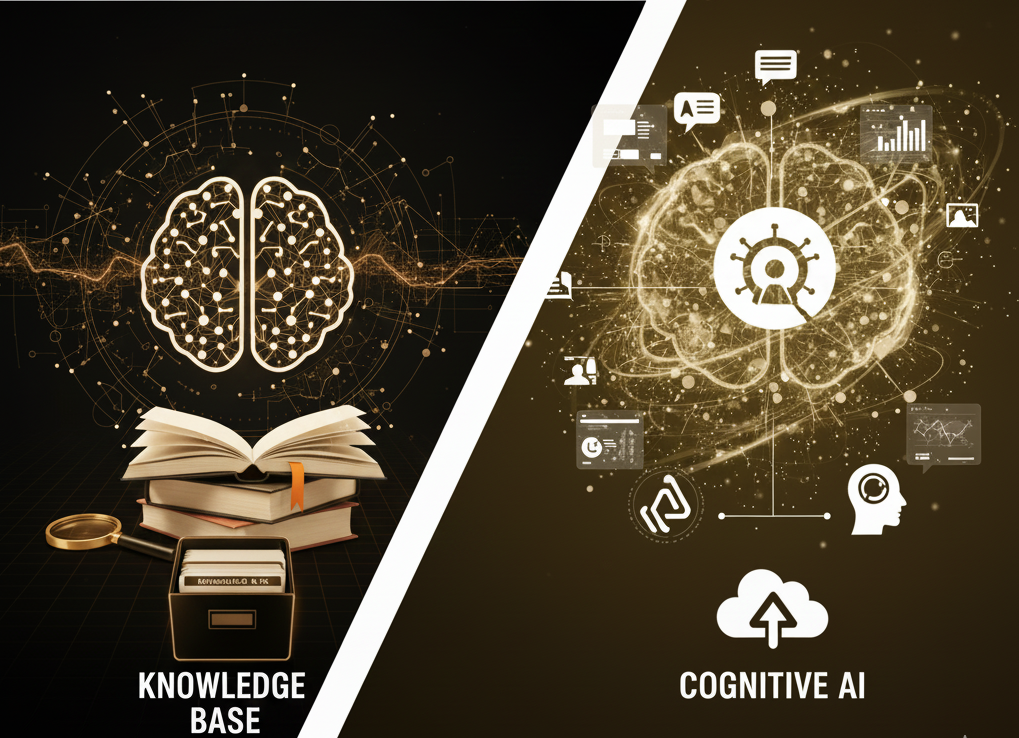
Knowledge bases store information. Cognitive AI models judgment. This piece explains why that distinction matters for luxury brands focused on consistency, confidence, and standards.

Julia Dietmar
Most organizations believe they have a knowledge problem.
In response, they build repositories. Playbooks. Intranets. Libraries of documents designed to capture what people need to know and make it accessible at scale.
In luxury retail, these systems are everywhere.
And yet, they rarely produce the outcomes brands expect.
Because the real challenge is not access to information.
It is knowing how to use it.
What Knowledge Bases Do Well
Knowledge bases are built to store and retrieve information.
They are excellent at answering factual questions:
- What materials are used in this collection?
- What sizes are available?
- What is the care guidance for this piece?
They create consistency on paper. They reduce reliance on memory. They make institutional knowledge searchable.
For operational clarity, they are necessary.
But they are not sufficient.
Where Knowledge Bases Fall Short
Luxury retail does not operate on facts alone.
The moments that define the client experience are rarely about retrieving the correct answer. They are about interpretation. Prioritization. Judgment.
A knowledge base can tell an associate what is true.
It cannot tell them what matters most in this moment.
It does not understand context. It does not adjust tone. It does not know when to simplify, when to elaborate, or when to pause.
As a result, knowledge bases often sit unused not because associates don’t value them, but because consulting them interrupts the very flow they are meant to support.
The Nature of Cognitive AI
Cognitive AI starts from a different premise.
Instead of asking, “How do we store more information?” it asks, “How do our best people think through situations?”
It is designed to model reasoning, not just recall.
A cognitive system understands that the same question can require different responses depending on who is asking, what the brand stands for, and what the moment calls for. It adapts language, depth, and guidance accordingly.
In other words, it operates closer to judgment than to documentation.
Context Changes Everything
Consider a simple client question:
“Is this suitable for an evening event?”
A knowledge base might return specifications, styling notes, or a generic answer. All accurate. All incomplete.
A cognitive system considers:
- The formality of the event
- The client’s level of confidence
- The brand’s tone and positioning
- What the associate should emphasize or avoid
The difference is not intelligence in the technical sense.
It is discernment.
And in luxury, discernment is everything.
Why This Distinction Matters Now
As AI becomes more visible on the sales floor and in training environments, the cost of misunderstanding this difference increases.
When brands deploy AI that behaves like an enhanced knowledge base, they often encounter resistance. Associates feel monitored rather than supported. Leaders see inconsistent outcomes. The experience feels efficient, but not elevated.
Cognitive AI, when done well, feels different.
It doesn’t replace the associate’s role. It sharpens it. It acts as a reference point for judgment reinforcing standards without prescribing behavior.
This is how technology earns trust in a human-led environment.
From Information to Intelligence
Luxury brands have spent decades refining how they train people to think, not just what to know. The next evolution of that effort is not more content.
It is better intelligence.
Knowledge bases will continue to play an important role.
But they will never be the source of excellence.
That comes from capturing how expertise is applied and making that thinking available, consistently, without stripping it of nuance.
That is the difference.
And it is the difference that matters.
Related Posts


See SartorIQ in action
A private walkthrough tailored to your brand, your teams, and your selling realities.